Preparation for Greece’s Panhellenic Exams has created a large and persistent supplementary-education market. On top of traditional spending on tutoring centres and private lessons, a second, highly fragmented layer has emerged: digital notes, formula sheets, exercise packs, final revision files, mock-exam material and ‘SOS’ resources.
The issue is not that every individual product is expensive or poor. The issue is that parents often have no reliable way to know whether their child has already covered what is being sold, whether the new material adds genuine educational value, whether it matches the official examinable syllabus and — most importantly — when preparation is actually enough.
The most expensive product in the Panhellenic Exam market is not a book or a private lesson. It is the question: ‘What if something is still missing?’
A market worth hundreds of millions
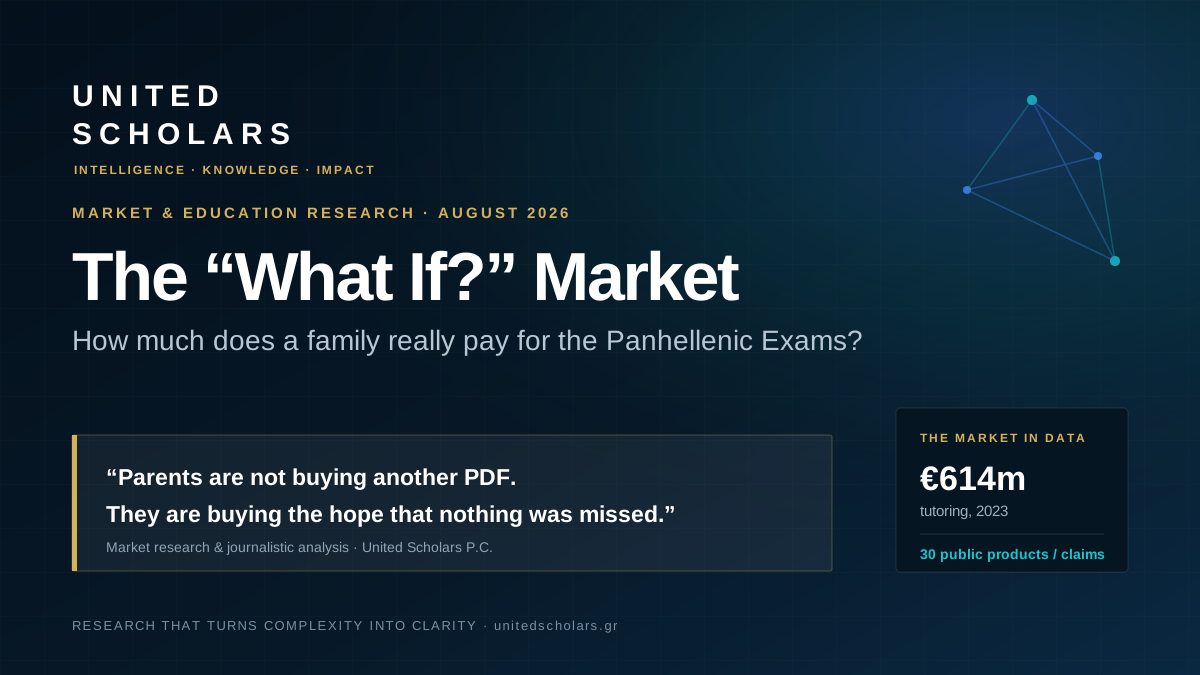
According to a KANEP-GSEE study, Greek households spent almost €614 million on general-education tutoring in 2023, the highest amount of the last decade. Some 94.6% of that spending concerns secondary education, while average family spending is reported at €180 per month. For households with monthly income of up to €750, tutoring expenditure corresponds to 24.1% of annual income.
The OECD also records a comparatively high dependence of Greek school education on private funding: private sources account for 21.7% of total funding in primary, secondary and post-secondary non-tertiary education, compared with an OECD average of 9.9%.
The second basket: PDFs, formula sheets and exercise packs
In the public digital marketplace reviewed by United Scholars, separate products were recorded for formula sheets, organised notes, theory by chapter, exercise packs, theory questions, past papers, ‘tips & tricks’ and exam simulations. On 22 August 2026, an 18-page AOTH formula sheet was listed at €5.83, organised notes plus formula sheet at €24.99, packs of 40 exercises at €9.99, and a digital reproduction of the Panhellenic Exam answer booklet at €5.99.
None of these products is inherently problematic. A high-quality study aid can be genuinely useful. The difficulty is that consumers often cannot easily distinguish between new educational value and another presentation of content they may already possess.
Three illustrative family scenarios
The scenarios below are not estimates of an ‘average family’ and do not imply that the purchases are useless. They are simple arithmetic simulations using public prices captured in the market scan, designed to show how quickly additional spending can accumulate when there is no single view of preparation progress.
When the label ‘final year of high school’ is not enough
For the 2027 Panhellenic Exams in General Lyceum (GEL), the official Economics syllabus has been set by the Ministry of Education and includes Chapters 1 to 5 and specified sections of Chapters 7, 9 and 10. United Scholars recorded 30 public products or commercial claims in its market scan. Under a strict mapping to the official GEL 2027 syllabus, five entries were classified as ‘out-of-syllabus core’ and seven as ‘mixed / extra content’.
This classification refers only to the relationship between the publicly described content and the specific official examinable syllabus. It is not a judgement of overall educational quality and does not imply anything about the creator’s intent. Examples in the scan included products on international trade and the balance of payments, competition/monopoly/oligopoly with references to Nash and Lerner, and a 400-exercise Chapters 1–10 bundle that combines core syllabus material with substantial extra content outside the official GEL 2027 syllabus.
‘400 exercises’ sounds impressive. For the candidate, the better question is: ‘How many of them do I actually need?’
The ‘SOS’ market and the illusion of control
As exams approach, the anxiety of students and parents creates particularly fertile ground for material marketed as ‘SOS’, ‘likely topics’, ‘final revision’ or ‘predictions’. Such material can have genuine educational value. The problem begins when the way it is presented suggests that it can materially reduce exam uncertainty or provide a special edge regarding what is likely to appear.
At such a sensitive point in the year, a family’s natural anxiety should not become a mechanism for additional purchase pressure. Claims around ‘SOS’ material and predictions need clear limits, transparency and verifiable documentation: what exactly is being proposed, how broad the topic set is, and what criteria are used after the exam to define a ‘success’. The point is not to reject targeted revision, but to avoid commercialising the fear that ‘something may still be missing’.
Why do parents keep paying?
This market has a characteristic economists call information asymmetry. The teacher knows the subject better, the creator knows the product, and the tutoring centre knows the programme it offers. Parents, however, usually do not know Economics at Panhellenic Exam level and cannot easily assess which material is necessary, which is repetitive and which is genuinely tailored to their child’s weaknesses.
In economic theory, services of this kind have characteristics of ‘credence goods’: even after purchase, consumers may struggle to know whether they needed exactly that amount of service or whether a different package would have been sufficient. In the Panhellenic Exam context, this is amplified by the perceived cost of making the wrong choice: no parent wants to discover afterwards that ‘something was missing’.
This is not an attack on teachers
The data do not support a generalisation that the problem is ‘tutoring centres’ or ‘teachers’. There are excellent educators, high-quality tutoring organisations, useful books and serious digital materials. The problem is systemic: the market is fragmented, while parents lack a single mechanism that tells them what has already been covered, where genuine weaknesses remain and which additional expenditure is actually necessary.
From consuming content to proving readiness
Education technology can change this relationship not by adding yet another digital shelf, but by making preparation measurable. Students need to know whether they have covered the full official syllabus, whether they can apply what they have studied, where they repeat the same mistakes and whether they can solve complex exam-style problems without assistance.
A student does not need to enter the Panhellenic Exams having bought everything. They need to enter knowing why they are ready.
In an education market that already costs Greek households hundreds of millions of euros, the meaningful reform is not simply to produce more content. It is to create more transparency, more precise targeting and — above all — evidence of readiness.